Tuesday, August 4, 2015

God Doesn't Need You to Worship Him

There was a time in high school that I remember scrolling through my Facebook feed and seeing an argument about religion. The only thing I remember reading was a quite brilliant kid saying that he saw God as a being that needed to be worshiped in order to have power. That bothered me when I read it but I decided it was best to not chime in on this conversation. It stuck with me though.

The recent turmoil in the country, as well as amongst members of the church, has brought this memory to my forefront of my mind. I feel as though it is time to address this misconception. There are people who have quite publicly left the church telling others to do the same if it doesn't bring joy and happiness to their lives. Having religion is not for the faint of heart, so if you can't see the benefits of it, then go right ahead. Leave. But I want to explain why it is important, even vital, that we stay.

God doesn't need you to worship him. Whether or not he is believed in by humans, does not eliminate the fact that he exists. Have you ever had a homework assignment that you either forgot about, or didn't know it was due on a certain day? It didn't matter whether or not you did it. Or believed it was due on a different day. The assignment and its due date existed. The same it is with God. Despite your personal beliefs, He is still there. His power and existence doesn't depend on us believing in and worshipping him. He has his power, and it cannot be revoked or changed. He can intervene, guide and protect us regardless of our religious affiliations. Doesn't matter if you are Mormon, Atheist, Buddhist, Jewish, or of any other religious persuasion. 

If He will put his plans forward no matter what, what does it matter what I do? Why do we need to worship him? Is obedience really that important? What is the point of these scriptures:

"If ye love me, keep my commandments" (John 14:15).

"Ye shall walk after the Lord your God, and fear him, and keep his commandments, and obey his voice, and ye shall serve him, and cleave unto him" (Deuteronomy 13:4).

"Again I say unto you, hearken and hear and obey the law which I shall give unto you" (D&C 42:2).

"Behold, I, the Lord, uttered my voice, and it shall be obeyed" (D&C 63:5)

We've been given our agency, the ability to choose and act for ourselves, so why is it that we are commanded to obey over and over again if it isn't for God?

It is for us. 

For us for various different reasons.

D&C 130:20-21 states:
"There is a law, irrevocably decreed from heaven before the foundation of this world, upon which all blessings are predicated- And when we obtain a blessing from God, it is by obedience to that law upon which it is predicated."

Commandments aren't restrictions placed upon us by some being that just has fun messing with his creations. Commandments are to help us be worthy of all the blessings that He has in store for us. 

The Lord has so much to give us, and all He asks is that we try it out. In Malachi 3:10 it says: 
"Bring ye all the tithes into the storehouse, that there may be meat in mine house, and prove me not herewith, said the Lord of hosts, if I will not open the windows of heaven, and pour out a blessing, that there shall not be room enough to receive it."
Pretty hefty promise for just trying it out. He is saying bring it on, and I will prove it. He isn't asking for blind trust, He is asking for experimenting on His words.


So if He has all of these blessings for his children, and He loves us, why doesn't He just give them to us?

This brings me to my next point. 

Have you ever met someone that is born into extreme privilege? They get whatever they want, whatever they want, without working for it. Nice cars, latest technology, fancy houses, and have traveled the world. It sounds pretty nice, right? Except, often they don't feel any gratitude for what they have. They don't know how to work. It is expected that everything to just magically appear. This isn't always the case but it is often true. 

Now look at the people who have had to work for everything they have gotten. They have a good work ethic. They are humble. They are willing to recognize who has helped them to get where they stand. They ask for help, not demand or expect it. They do not live frivolously and are grateful for what they do have. 

If your work and glory is to "bring to pass the immortality and eternal life of man" (Moses 1:39), what would you like as an end result? A bunch of spoiled children who don't understand how to work,  the reason why this has all come to pass, or have any semblance of a relationship with you? Or option B: children who have a good relationship with you, have learned what you needed them to learn and have appreciated all that you have done for them? I don't know about you, but I personally would like option B. 

How can we fully appreciate the suffering that Christ has done for us (Alma 7:11-12D&C 19:16-19) if we do not have to plead for and be worthy of his atoning power? How can Heavenly Father's work go forward, if we do not have to work to receive the blessings of that work? The work can go forward with or without you. But the blessings and benefits of that work only extends to you if you are apart of it. Which includes worship of and obedience to God.

But if all of these blessings come from obedience, why am I not happy and joyous when I am doing all that I can to be obedient?

It does seem unfortunate when we are doing all that we can to be obedient and we still find ourselves in the middle of very difficult trials. Sometimes we say to ourselves, "Ok, I am still going to do everything that I can do be obedient, then it will all go away." Then it actually gets harder. Then we think to ourselves, "Why do I even try?"

Here are some questions to ask yourself when these thoughts come:
Am I really doing all that I can to serve the Lord?
How has the Lord blessed me today?
Could it be worse if I didn't have the faith and the testimony that I do have?
Am I using my faith and testimony as much as I could be?

I have had hard days in the middle of hard trials, and thought, "How could I deserve this?" Then I would say a prayer pleading for help. The prayer would always get answered, but never with a sudden removal of all burdens and have the day be turned completely around. Most of the time the day is still hard. But I have lived to tell about it. And I usually came out of it with a couple of lessons that I was then able to implement into my life. 

It is not that we deserve or earn certain trials. Sometimes trials come in consequence to our sins, but it is not the only reason for them. 
Mosiah 23:21 says "Nevertheless the Lord seeth fit to chasten his people; yea he trieth their patience and their faith."
Applying the principle of becoming a hard working, humble people who have a good relationship with our Heavenly Father- this is how. We cannot fully develop Christlike attributes if they are not put to the test. We cannot be able to come out of a class with a complete knowledge of what is taught, if we do not learn, study and put to it to the test. In order to ace a test, we have to study, learn and be able to apply the test materials. And like all lessons, Christlike attributes are a use it or lose it kind of thing. We do not learn them once and suddenly have that attribute mastered. It has to be tested over and over again before we can perfectly master it. Which means different trials are going to come in order to test the attributes that we are trying to acquire.
 But we do not have to study alone. 
The following verse in Mosiah says, "Nevertheless- whosoever putteth his trust in him the same shall be lifted up at the last day. Yea, thus it was with this people."
Within the scriptures, we have multiple accounts of people going through difficult trials, relying on the Lord, and they have their burdens lightened and they come through better, more faithful people. Their burdens aren't taken away because they ask for help through out their trial. But they are able to carry them. Whether the burden is lighter, or they become strong enough to carry the burden, it doesn't matter. What matters is, they get the help they need because they are faithful.


A line from one of my favorite movies says “Perhaps, instead of asking questions of our trials, our trials are meant to ask questions of ourselves.” Also in that movie it is said, “It is the glory of God to conceal a matter, it is the honor of kings to seek it out.” Concealed deep within us is an incredible thing. It is the absolute best versions of ourselves. Specially designed to further the great and marvelous work that Heavenly Father has planned. Part of being ready to complete that work is going through the refining and purification process that is the reason for many trials. We can not enjoy the joys of understanding, fulfillment and an incredible relationship with our Heavenly Father that can come out of trials if we do not first put the in hard work, cry the ugly tears and carry the heavy burden of trials.


A scriptural example of why worship is for us, not for God. 
Numbers 21 tells us a story of the children of Israel being bitten by fiery serpents that caused the death of many. Moses is told to make a serpent out of brass and raise it up for the people to see. If the people looked to it, then they would be saved. If not, they would die. 
Seems pretty simple, right? If it is going to save you, then why not try it right?
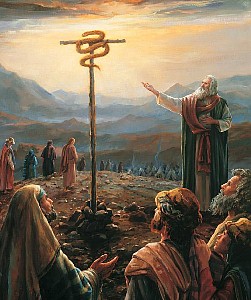


In this story, the serpent of brass represents Christ. He was raised up on the cross, after suffering in Gethsemane, so that all might be saved. All it takes for us to receive that power, is to look to him. If we direct our lives towards him, living the way He did, acting the way He would have us act, then we can be saved. Whether or not we do it, He is still there. His atonement still happened and is available to us. Just as the brass serpent was raised and its saving power was there for the people to use.
What saved the people was looking to it. Some did and they were saved. Others didn't because they felt it was too simple, or they didn't believe it would work. 
So it is for us. Are we going to worship because we can't believe it would work? Because things stand in our way? Because the world tells us that it is out of date, and our beliefs are not in popular view? Are we going to let other imperfect people, who are in the middle of working out their own impurities stand in the way of cleaning up our own imperfections? Are we going to sacrifice our own spiritual lives for the sake of it being difficult?

God does not want us to worship him for his own self pleasure. That seems pretty selfish for someone who is willing to sacrifice his own Son for the sake of all mankind. It is purely for our benefit. We do not have to be perfect to worship Him. Worshipping Him is how we become perfect. He wants us to return to Him. He wants to help us. But He can't if we aren't willing and ready to receive it. 

I know that God lives. I know that everything He does is for the benefit of mankind, as well as for the benefit of each individual soul. He is aware of each and every one of us. His commandments are to help us and protect us from the painful consequences of sin. It is through following him that we can find joy and happiness in our lives. That doesn't mean we won't prevented from feeling heartache and pain. But He will help us through that, as well as to find joy in our journey. It is when our hearts are fully turned to him in worship that we receive those benefits. His benefit is the joy in having His children close to him and receiving all that He has in store for us. I have found this to be true for myself. It is my hope that you take these words, and do what you can to find out for yourself if it be true.

Sunday, June 14, 2015

"By Small and Simple Things..."

I recently moved to Boston. (Yay!) To start Occupational Therapy school. (Finally!) Which is why I have been radio silence for the past few weeks. This semester we only have a two classes. One of which is anatomy, including a cadaver lab. 

This anatomy class was not the only one I have taken in my life. I took many classes while working towards my associate's degree where I had to know the muscle attachments and their actions, alongside the traditional anatomy classes. At BYU, I took an functional musculoskeletal anatomy class where we had to know anatomy inside and out. I thought I had all of the spiritual insight about the human body I could possibly get. I mean, I went to BYU, I learned from LDS professors about how amazing the human body is. They understand it is an amazing gift from Heavenly Father, so what more could I possibly learn? Welp, that's what I get for thinking.

In class the other day, my teacher was discussing the brachial plexus. Which is a nerve complex that comes from the lower neck out to innervate the muscles in the shoulder, elbow, wrist and hands. My teacher was trying to explain to us how the nerves come from the spinal cord, and she goes off on a slight tangent. She said that the spinal cord is really small and boring when you look at it on a cadaver. It's just this white thing that isn't very big. Same with the brain. When the class started to comment on how that is weird, she commented that she was expecting large flashing neon lights to point out the spinal cord, and was disappointed that it what just this tiny little cord. The class laughed and we moved on. 

But then a scripture mastery verse came to mind. "By small and simple things are great things brought to pass... And the Lord God doth work by means to bring about his great and eternal purposes... and bringeth about the salvation of many souls" (Alma 37:6-7). 

Our body parts did not come with big, flashy, neon colors to say "Look at me! I'm a spinal cord!" or "Check out what I can do!" For one thing that would make anatomy class way too easy. Not to mention how uncomfortable would that be to have sticking out of our backs?

The jobs of the brain and spinal cord are incredible. They are what makes the whole rest of our body function properly. Our nerves are what makes our muscles move! But when you look at them inside the body, they are just these small, white pieces of tissue. They aren't that impressive to look at, but so incredible when we begin to understand all that they do.

This is just one example of small and simple things that Heavenly Father uses to accomplish his purposes. How many times do we pray for an answer or a testimony, demanding this big huge event to occur so that we can understand and believe? I mean it happened to Joseph Smith and other prophets. We've know that miracles happen. We hear those stories all the time in sacrament meeting, so isn't that supposed to happen when we ask for an answer? 

The prophet Elijah, a prophet who did a great number of things in his life, had this experience:
"And he said, Go forth, and stand upon the mount before the Lord. And, behold, the Lord passed by, and a great and strong wind rent the mountains, and brake in pieces the rocks before the Lord; but the  Lord was not in the windL and after the wind an earthquake; but the Lord was not in the earthquake: And after the earthquake a fire; but the Lord was not in the fire: and after the fire a still small voice. And it was so, when Elijah heard it, that he wrapped his face in his mantle, and went out" (1 Kings 19:11-13)

The end of this story is Elijah is told to call Elisha to be the next prophet. Not by an earth shattering voice was Elisha, another great prophet, called. Not an earth consuming fire. But by the still small voice.

Yes, there are times that the Lord uses big grand gestures. Those a big deal events for the world. Usually done to get the ignorant and prideful attention of the people who have blatantly turned away from him. But if you search the scriptures, it is not the big events that stick. Laman and Lemuel saw an angel. But they still feared Laban more than God. The Jews saw the miracle after miracle done by the Savior. Still the crucified Him. Huge events aren't what makes testimonies.

But what about Alma the Younger or Saul on the road to Damascus? Both made huge turn arounds after having an angel come to them and condemn their actions. This is what Alma said to his son how he gained a testimony:
"Do ye not suppose that I know of theses things myself? Behold, I testify unto you that I do know that these things whereof I have spoken are true. And how do ye suppose that I know of their surety? Behold, I say unto you they are made known unto me by the Holy Spirit of God. Behold, I have fasted and prayed many days that I might know these things of myself. And now I do know of myself that they are true; for the Lord God hath made them manifest unto me by his Holy Spirit; and this is the spirit of revelation which is in me" (Alma 5:45-46)

The angel didn't come to Alma, rack him with torment, and then when he finally turned to Christ, he suddenly have this huge testimony. Nope. He got it the same way that you and I receive our testimonies. By trying the word. Praying about principles. Fasting for answers. And acting on the knowledge that he received through the Holy Ghost. It is through doing the small things that we receive testimonies, make a huge difference in another person's life, and return back to live with the Father and Christ. As much as we want the big things to happen, how can they if we don't lay the foundation? How can we have a miraculous healing, if we first don't have the faith that it can happen? How can we run, if we don't first learn to sit up on our own?

Sure. It would be super cool if our spinal cords and brain were neon and stood out really well. It does some super cool things. But it is not necessary. What is necessary is to have a small control center so that we can do the big and little things while living comfortably. It is not necessary that God strikes every sinner down, or appear to every person wanting to know the truth. That does not build faith. Just as a neon spinal cord does not enhance our movements. It is when we are willing to take a step into the dark that we receive light. A small step may be what we need to start us down the path to eternal life.


Monday, May 4, 2015

BYU did NOT prepare me for my career

A week and a half ago, I graduated from BYU

I will be forever grateful for all that I have gained from receiving a BYU education. When people not of my faith would ask me why I chose BYU when I grew up in an area full of universities, I would give some explanation regarding cost and how BYU was cheaper in tuition and housing than just in state tuition and living at home. But that isn't the real reason why I chose there. When I set foot on campus as a freshman in high school, I immediately knew that this school was different and special. I felt drawn to it. Instead of my senses being bombarded by cigarette smoke and curse words, I felt peace and serenity. I didn't even have to sit in on a class to know that this school was the one for me. I knew I was going to have to work hard to get in and work hard while attending but I knew it was worth it. 

And it was. There were experiences and educational opportunities given to me at BYU that I would have no other place. With that being said, BYU did not prepare me for my future career. Some might be able to walk out of a university graduation and into their chosen field. That is not me. Occupational therapy asks for a graduate degree, and so that is what I am about to go earn. BYU doesn't have an Occupational Therapy program, and so my BYU educational experience did not prepare me to be an Occupational Therapist. But that is okay. I knew that was going to be the case. I didn't go to BYU to become an Occupational Therapist. I knew BYU could prepare me for so much more.

BYU prepared me for Occupational Therapy school
So I'm not ready to enter the work force as an occupational therapist. That's ok. I am prepared to enter occupational therapy school, in a program that is almost unmatched in its curriculum plan. Throughout my major, I studied the ethical dilemmas that face an occupational therapist. So when these problems arise in my clinicals, I will not only have the education to know how to handle it, I will have the decisions made beforehand as to how I would react. I have an understanding of the nerves work. Which is highly important because those are the exact skills I will be working with. My point is, as long as you do the research on majors, BYU's undergraduate education prepares students to go on professional schools, if they so choose.

I was spiritually prepared for sacred covenants
I basically walked out of the middle of my convocation and walked into the temple to receive my endowment. Ok there was stuff in between but that is pretty much what I felt like what happened. Throughout the session I never once felt out of place or that what was happening was weird. I felt completely like I came home and that I had been there before. Much of that can be attributed to the religious education that I was given at BYU. In my family history class, we spent the last two weeks talking about the history of the endowment, what goes on in the endowment and why we have it. In my Old Testament classes, we talked a lot about ancient temples and worship and how it relates to our times. My church history teacher taught us the history of the current endowment, how it came to be and how it has since been changed. I walked into the temple knowing what I was getting into (as much as I could). I wouldn't have had that ability if I had merely gone to institute and temple prep.

I learned how to put religion and secular education together
At BYU what I learned in my physics class was applied in my Old Testament class when we discussed the creation. My chemistry teacher flat out told us that his class was a religion class, not a science class (What he didn't include in that statement that we had to rely on our ability to pray to pass his tests, rather than our ability to learn.). Our discussion of trials in my Book of Mormon class had application in my basic athletic training class discussion on the principle of overload and adaptation. My Old Testament teacher was able to put a life metaphor to what I was learning in my ceramics class (that's a whole different blog post). Nearly every class, religion or not, started with a prayer. BYU didn't teach me I either had to have science or religion. BYU used science to prove religion, and religion to further scientific application. That is an education you would not be able to get anywhere else.

I was prepared to serve my fellow man
BYU's classic sign says "Enter to Learn, Go Forth to Serve." I will admit that I did not serve as much as BYU as I should have or could have. The only time I was involved with a service organization was for the blue foam slide, and it was so I could have unlimited runs after the crowd was gone. But I had many church leaders that taught me how to serve in the church. My teachers showed me what it was like to be understanding and accommodating to other's needs. I learned how I could serve in little ways, reaching out to the one with little recognition over the large recognition and not making much of a difference. My chosen field is a service field. I will be able to combine the education on service I had, inside and outside the classroom, at BYU with the OT education in graduate school to best serve my fellow man.

So BYU did not prepare me to sit for the licensing test to become an occupational therapist. No undergraduate degree would have. It requires a masters or better. BYU was not my chosen school because it would make me a better OT. That is a side benefit. I chose BYU because it would make me a better person and prepare me for my life. I feel like I can be of better service to my fellow man and to my Father in Heaven because of my BYU education. Is BYU perfect? Nope. But there isn't a university that is, except the temple. But I am forever a better person because of my BYU educational experience.

Sunday, March 22, 2015

Miracles Take Time...and Work

I have been thinking a lot about miracles today and I had a thought that I hadn't had before.

This week I found out that I was accepted into occupational therapy school. As you can imagine, I am incredibly excited to start this new adventure. Throughout the application process, the observation hours, the interviews and now the preparations to go I have been thinking a lot about what it will be like to actually be an occupational therapist. In a previous post, I talked about how I realized that it is my mission from the Lord. And this week I have come one step closer to being able to "enter the mission field" so to speak. 

So what does OT have to do with my new perspective on miracles?

Today in Sunday school we were talking about burdens and how the Savior can make them light. The context that we were discussing these burdens had to do with following all of the rules that the Pharisees had put on the people in order to keep the Law of Moses. We then read examples of the Savior healing on the Sabbath day and the Pharisees were trying to point out that he was doing wrong. In their eyes no work was to be done on the Sabbath, no matter the intentions and good that it could accomplish. 

While this discussion was going on, my mind went off into another direction. 

I thought of all of the "famous" miracles. You know, the ones that we always talk about because they are so cool. The woman with the issue of blood being healed by touching the Savior's cloak. The parting of the Red Sea. Alma the Younger and the sons of Mosiah seeing an angel and having a miraculous change of heart. The raising of the dead. The Day of Miracles in Nauvoo when all of the saints were sick with malaria. 
This one is my personal favorite to read about:

Why are they so cool?
The instantaneous change that was experienced. Faith was tested. Results happened instantly. Results that could not be replicated by anyone else without proper priesthood authority and authorization.

Then I thought of a discussion I had had with one of my friends who just got off of a mission. I was telling her about how I had felt that occupational therapy was my mission. She told me about in a class she was auditing on health professions, an occupational therapist had come in a talked about the profession. She told me that the therapist loved her job because she got to be the hands to the Savior daily. She gets to spread his healing to her patients.
When I recalled this, I thought "But therapy takes time to see results. The Savior's miracles happened right away. How is it that I will get to be the Savior's healing hands when I won't be able to get instant results?"

Then I remembered other, less famous, miracles. Naaman, an Assyrian, was healed of leprosy only after he washed in the river Jordan seven times (2 Kings 5). It took Nephi and his brothers three tries to get the brass plates from the wicked Laban (1 Nephi 3-4). The Apostle Peter went from weak faith to leader of the church. Not in one day, week or month. But it took learning at the Savior's feet for 3 years and then months after the Savior was resurrected. The Book of Mormon and Bible were not translated in a couple of days. Even some of the Savior's miracles took actions and stages: 

(The miracle is over at 3:40)

Was faith tested in these miracles? Definitely. But they also took time and work for the miracles to be fully complete. 

We live in a time when everything happens instantly. It takes me longer to tie my shoes that it does to look up the weather forecast in Tahiti. We are so easily caught up in the moment. You know how the cheer goes." What do we want?" (Insert want here)" When do we want it?" "Now!"
 That is how society lives their lives. 

Yes, instantaneous miracles do occur. The miracles recorded in the scriptures teach us that. I have had  priesthood blessings of healing that the healing took place as soon the hands were placed on my head. It can happen that way if the Lord wills it.
On the other hand, I have had other blessings of healing (for a similar issue and other problems), that took hours, days or years to come true. I had to place my trust in my Father in Heaven, and completely turn my will over to him in order for that answer to come. 

Repentance doesn't happen in one day. Conversion does not come with a single spiritual experience. Healing (physically, spiritually or emotionally) does not come with a single treatment. 

It takes the effort of restoring all that was done wrong and never returning to that sin to be forgiven. It takes daily spiritual experiences to make the conversion stick. It takes continuous prayer, rehabilitative work and fighting the urge to give up that healing is brought about. 

It is my testimony that prayers are heard and answered. All of God's promises come true. I know that He has a plan for each of us. Sometimes the instant reward is what we need. But more often than not, it is the learning how to work towards our goal of receiving the desired blessings is what we need. It is through our work, patience and diligence that molds us into the people that are worthy of those blessings. They may not come today, next month, in five years, or even in this life. But I promise, they do come.


For further study:
Miracles- Then and Now by Thomas S. Monson November 1992
The Miracle I Needed- New Era February 2010


Monday, January 26, 2015

Lessons from King David

One of my classes this semester is the second half to the Old Testament. It is a continuation of the class I took last semester. 

There is some overlap between the two, in order to give proper background to students who didn't take the first half. Our reading a few weeks ago was the story of how King David came to power and his victories and falls during his kingship. Reading this reminded me of how we ended the class, and the thoughts that I had as the semester was ending.

David was chosen over all of his strapping older brothers to be anointed as King. He defeated a 9 foot giant with a sling and divine help. He forgave Saul multiple times for attempting to take his life. He unified a disjointed and separated Israel. He wept for his enemies. 
David was an amazing man. No wonder the Lord selected him to lead Israel. David was loved by the Lord. David put the Lord first in his decisions and relationships. The Lord adored him and blessed him for his goodness.

But then he stumbled. He should have been with his armies in battle. He should have looked away from Bathsheba on the roof. He should have, he should have. I can sit here and list all of the things that he could have done or should have done. Let's be real here. David may have been an amazing man with a good relationship with the Lord. But he was also human. He still was subject to temptations and in this instance, he succumbed to it. I can't say I haven't made mistakes and fallen to temptation. I can't say I wouldn't have made similar decisions in his situation. Basically, it isn't our place to judge his mistakes. But the story is there for us to learn from, so that we can avoid and learn from his mistakes.

Lesson 1: It doesn't matter how good you have been, temptations are going to come, and come on strong. We have to always be prepared to withstand them.

There are many times that I have wished that once I receive a certain level of righteousness, all of my temptations would go away. That's just not how it works. The more that we practice saying no, the more strong and subtle the temptations will become. Satan knows us, he knows our weaknesses and how to use them to make us falter.

But that doesn't mean that we should just succumb to them because it's inevitable. That isn't the case. There is an example of one who was able to overcome all temptation.
Mosiah 3:7 states: "He shall suffer temptations, and pain of body, hunger, thirst and fatigue, even more than man can suffer..."
He went through more temptations than what we will be able to go through, and he came out on the other side as the one perfect person to walk the earth. He knows how to overcome them. Studying his life and how he overcame the many temptations that came his way will help us learn the tools that he used.

One tool is one that we can use and should use it often is prayer. When he was in the Garden of Gethsemane, he prayed multiple times:
"Father, if thou be willing, remove this cup from me..."
He was in pain. He was tired. He didn't want to do what he was about to do. So much that he pleaded for another way. He was tempted to give up. But then he says the saving line:
"nevertheless not my will, but thine, be done."
He was humble enough to say, I will go through with it, if you want me to. I think the following verse tells us there was a little bit more to that prayer though.
"And there appeared an angel unto him from heaven, strengthening him" (Luke 22:42-44)
Whether or not he actually prayed for divine help, Heavenly Father knew that it was needed, and sent an angel to help him through it. The same can be with us. Whether it is through an actual angel, or someone on earth sent to help us, or just divine strength it doesn't matter. What matters is when we pray for strength to resist temptation, we will receive it.

1 Corinthians 10:13 tells us that we will not receive any temptation that is unique to us. And when we receive temptation, it is not what we can't handle, and there is a way for us to escape it.
Pretty cool, huh?
But how can we do that? Alma 13:28 gives us the answer:
"But that ye would humble yourselves before the Lord, and call on his holy name, and watch and pray continually, that ye may not be tempted above that which ye can bear, and thus be led by the Holy Spirit, becoming humble, meek, submissive, patient, full of love and all long suffering."

Keep a prayer in your heart to help you resist daily temptations. When something is really difficult to resist, say a quick, humble prayer, pleading for divine help and guidance. Ask to help know yourself, so that you can be aware of your weaknesses. This will help you to avoid tempting situations. If they are unavoidable, you can go into them with a protective prayer to strengthen you throughout the whole time you're subjected to the temptation. I personally have done this and testify that this works. But don't just take my word for it. Try it out for yourself and see how it turns out for you. If you do it will real intent, you will see for yourself that you can receive divine strength to avoid temptations.

And if worse comes to worse, and you need a last resort, there is always Amulek's approach.

Lesson 2: Consequences always come

After David committed adultery and then arranged the death of Uriah, there were some consequences that he faced. While he was alive, Bathsheba's first child was lost. Nathan, the prophet, promises a curse of evil into David's house. Then it came true, when things slowly began to fall apart. (See 2 Samuel 12)

To be honest, all of those things that David went through in the rest of his life, he could have handled without too much fuss. Yes, they were hard, but he came out alright. It is the spiritual consequences that proved to be too much.
D&C 132:29 tells us that from this mistake he lost his exaltation. It wasn't so much the adultery was the problem, even though that is a grave sin in and of itself.  David didn't follow the law that sanctified life. He had taken many lives before but it was in war, in the protection of his people, or righteously avenging lives. He had already displayed restraint when he spared Saul's life, even though his own was threatened by doing so. David knew that is was wrong to take Uriah's life, but still designed his death. Murder is one of the big three sins with God. So as a result of completing this act, he lost his exaltation.

D&C 130:20-21 tells us:
"There is a law, irrevocably decreed in heaven before the foundations of this world, upon which all blessings are predicated-
"And when we obtain any blessing from God, it is by obedience to that law upon which it is predicated."
Logic follows that if blessings are set forth from heaven before the world was, punishments must have too.

In our world today, the common culture is to want to be able to do whatever we want, get whatever we want and suffer no consequences for it. Have an unplanned baby because you decided to have sex out of wedlock? Make abortion legal. Make poor business choices? Have the government bail you out. Don't want to work? Get yourself fired and have the government pay you to not work.

Look at what David did. He tried to do the same thing. He tried to do whatever he wanted, and once he got it, he couldn't handle the consequences. Then he tried to cover it up, only to make it worse. It simply does not work to try to slip out of the consequences that are bound to come.

Moral of the story: get the good consequences. Be righteous and receive the blessings in consequence to your actions. If you slip up, own up to it, repent and move on.
After seeing what happened to David, I will gladly take the world's judgments over God's judgments. I want to be able to live in the presence of God, even if I have to deal with scornful gazes of those around me.

Lesson 3: Forgiveness and love can be attained from the Lord, no matter what.

So David's life has shown us the bad that can come from our poor choices. But his life can also give us hope for when we do slip up.

David could have easily fell all the way down the slippery slope he was on, and just stayed at the bottom. But when Nathan brought to his attention just how serious of a sin he committed, he began the process of repenting and trying to get back to the Lord. He wasn't perfect before the even with Uriah, and he wasn't perfect after. However, he did all that he could to be righteous.

That is evidence in his psalms and in the mercy he tried to extend to his enemies. He praises the Lord, and continually prays for forgiveness, mercy and protection. And he receives it.
In Psalm 13, David tells the Lord, I know that I have done wrong and you have removed your spirit from me, but I trust in your mercy and salvation because all that you have done for me before.
He tried to be faithful again. He knew what the Lord could do and so he trusted in Him again.

Then in Psalms 32:5, David says the unthinkable:
"I said, I will confess my transgressions unto the Lord; and thou forecast the iniquity of my sin."
David felt he was forgiven! Even after all that happened.

Did that remove the eternal consequences? No. He still lost his exaltation. That can't be removed, like the scripture says. But he was still forgiven.

We will make mistakes that we will have to repent from. And we will pay for the consequences of those mistakes. But no matter what, even if we commit very serious sins, we can still be forgiven and feel the love of the Lord in our lives once again.
I think that is the most important lesson that we can learn from David.
Forgiveness is available to us, if we work for it and turn our hearts back to the Lord.