Friday, June 19, 2020

Reconciling Racism and Mormonism: An opportunity for change

Am I allowed to start this by saying, "What is 2020?" We all joked about having 2020 vision this year but I don't think we had any insight to what 2020 would bring us. Each month has seemed to attempt to top the level of crazy we were experiencing. 

During these months, I have had so many thoughts roll into my head of what to say in a blog post to offer support or words of encouragement but none of them felt right to say. And then something new would happen and again I would think about what to say, but the words left my head almost as soon as I started to think them. 

Then May happened. And the pressures of continued racism came to a head. I have been reluctant to write any words regarding this for many reasons. I did not want to add any false or misleading words to the rhetoric that is being shared by all viewpoints. I did not want to be another person sharing my white guilt but still not offering true hearted support to those that are actually experiencing racism and hate. I wanted the people who had authority to speak to be able to be heard without adding to the noise. I also watched people who loved each other, tear each other down on social media in an attempt to make themselves feel better. But now there are words in my head that have moved to my heart that I must get out. 

Before I dive in, I just want to say, nothing in this post is meant to be condemning or accusatory in anyway. If you have a strong response to my words, please know that my goal is to educate and to promote thought, rather than to place judgement. As I often teach the kids I work with, emotions are our body's way of telling us how we are responding to a situation. So listen to those emotions and try to understand why you have them. 

Art by Greg Olsen

I have seen a video going around the last few days entitled "White on Purpose". It is a thought provoking video discussing how the LDS church has a history of racism and promoting the question of how we have inspired leaders while still having this strongly biased history. I have also seen a similar medium article pointing out the leaders of the early church having a history of racism and how members need to be better. I have since lost the link so I have not put it into this post, but I will edit it later if I find it. 

I have really tried to think about the points raised in these posts, along with the tweets made by Joanna Brooks referenced in the videos. Here is how I can belong to a church that has this history, abide by the gospel, and hope to change for the better with that knowledge:

The beginnings 

First, let us just look at Christianity and racism in general. A lot of people that owned slaves in the past, were God fearing people. They attended church every Sunday, contributed to society and served their community. Looking at this now, that may seem counterintuitive. People that believe God loves all, are also literally owning another person. But let's think about where racism starts in Christian texts: the story of Cain and Abel.

Genesis 4 states:
And Adam knew Eve his wife; and she conceived, and bare aCain, and said, I have gotten a man from the Lord.
And she again bare his brother Abel. And Abel was a akeeperof sheep, but Cain was a tiller of the ground.
And in process of time it came to pass, that Cain brought of the fruit of the ground an offering unto the Lord.
And Abel, he also brought of the afirstlings of his flock and of the fat thereof. And the Lord had respect unto bAbel and to his coffering:
But unto aCain and to his boffering he had not crespect. And Cain was very wroth, and his countenance fell.
And the Lord said unto Cain, Why art thou wroth? and why is thy countenance fallen?
If thou doest well, shalt thou not be aaccepted? and if thou bdoest not well, csin lieth at the door. And unto thee shall be dhisedesire, and thou shalt rule over him.
And Cain talked with Abel his brother: and it came to pass, when they were in the field, that Cain rose up against Abel his brother, and aslew him.
¶ And the Lord said unto Cain, Where is Abel thy brother? And he said, I know not: Am I my abrother’s bkeeper?
10 And he said, What hast thou done? the voice of thy brother’s ablood crieth unto me from the ground.
11 And now art thou acursed from the bearth, which hath opened her mouth to receive thy brother’s blood from thy hand;
12 When thou tillest the ground, it shall not henceforth yield unto thee her strength; a afugitive and a vagabond shalt thou be in the earth.
13 And Cain said unto the LordaMy punishment is greater than I can bear.
14 Behold, thou hast driven me out this day from the face of the earth; and from thy face shall I be hid; and I shall be a fugitive and a vagabond in the earth; and it shall come to pass, thatevery one that findeth me shall aslay me.
15 And the Lord said unto him, Therefore whosoever slayeth Cain, vengeance shall be taken on him sevenfold. And the Lordset a amark upon Cain, lest any finding him should kill him.
Moses 7:22 adds:
22 And Enoch also beheld the residue of the people which were the sons of Adam; and they were a mixture of all the seed of Adam save it was the seed of Cain, for the seed of Cain were ablack, and had not place among them.
Then there is the case of Ham (father of Canaan), Shem, and Japheth. Ham finds his father, Noah, in a drunken, naked state. He tells his brothers, who cover up Noah without looking. When he wakes up, Noah proclaims:
25 And he said, aCursed be bCanaan; a servant of servants shall he be unto his brethren.
26 And he said, Blessed be the Lord God of Shem; and Canaan shall be his aservant.
Right from the very start, we have a separation of people, a "curse" placed to mark the skin of the sin of one man. Now we don't know exactly if the people's skin were literally dark, or if it was a metaphor like many other terms in the Bible. But what we do know, is that many people have used this curse as a reason to view someone with dark skin as being "worse" than someone with light skin. This was the view adopted by many people that were slave owners, or justified their racists views in the last few hundred years of society. 

We also see a similar example in the Book of Mormon. Alma 3 states:
And the skins of the Lamanites were dark, according to the mark which was set upon their fathers, which was a acurseupon them because of their transgression and their rebellion against their brethren, who consisted of Nephi, Jacob, and Joseph, and Sam, who were just and holy men.
And it came to pass that whosoever did mingle his seed with that of the Lamanites did bring the same curse upon his seed.
14 Thus the word of God is fulfilled, for these are the words which he said to Nephi: Behold, the Lamanites have I cursed, and I will set a mark on them that they and their seed may be aseparated from thee and thy seed, from this time henceforth and forever, except they repent of their wickedness and bturn to me that I may have mercy upon them.
In both texts, we see that people with dark skin are cursed as punishment of one person's actions and the whole group is looked down upon as a result. These views easily were adopted by people of the church.

The early church and racism

Now let's look at the founding members of the church and their views. The church was founded in 1830. A time in which slavery existed. Members experienced extreme hate and persecution, leading to mass migration from New York, Ohio, Missouri, Illinois and then eventually what would become Utah. 
I followed the citation of one of Joanna Brook's tweets to this site. It is a academic thesis covering Utah's history with slavery and analyzes the role that leaders of the early church has with this. 
First he talks about Joseph Smith's own views of slavery. Which is hard to tell because he appeared to be neutral, with the exception of his presidential campaign in 1944. But if you think about society at the time. Slavery was real. The church had spent a good period of time in Missouri, which was a slave state. And the history covered in this thesis shows that if the church was anything but neutral, mobs would form (page 26). So by self preservation, they attempted to stay neutral, as persecution was already very high at the time. 
Then the church moved to Utah, began to gather converts that were slave owners, and continued on in a social culture of racism and segregation.
Then we get to Brigham Young, who wrote in his own personal history:
The negro...should serve the seed of Abraham; he should not be a ruler, nor vote for men to rule over me nor my brethren. The Constitution of Deseret is silent upon this, we meant it should be so. The seed of Canaan cannot hold any office, civil or ecclesiastical....The decree of God that Canaan should be a servant of servants unto his brethren (i.e. Shem and Japhet [sic]) is in full force. The day will come when the seed of Canaan will be redeemed and have all the blessings their brethren enjoy. Any person that mingles his seed with the seed of Canaan forfeits the right to rule and all the blessings of the Priesthood of God; and unless his blood were spilled and that of his offspring he nor they could not be saved until the posterity of Canaan are redeemed.


He wrote and said many similar racist views, citing that curse of Canaan as the reason why people of color should not have any civil rights. Brigham Young was not the only church leader that was racist. This is what led to Utah legalizing slavery. And these views did not change for a long time. If fact, there are still many in Utah experiencing the effects of the racist culture established in Utah from the beginning. 
Please, whatever you do, do not let this part be the last thing you read of this blog. It gets better, I promise.

How do I reconcile this?

Okay, so learning that beloved and revered church leaders were racist is not exactly a happy thought. There are many that look at the church's history and leave as it is not in line in how they feel good believers of the church should act. So how do we reconcile this?

First let's make three things clear:

1: When I was at BYU, I was fortunate to take "Teachings of the Living Prophets" from Lloyd Newell (the voice of the Tabernacle choir). Something that he emphasized weekly in class was that we do not believe in infallible prophets. What he meant by that was the men who lead the church are not perfect. We learn many times over in the church that humans are not capable of perfection in this life. The flesh is carnal and susceptible to temptation, weakness and flaws. We cannot expect anyone in the church, including any of the current or past leaders to be perfect. That is setting everyone up for failure. 
He also taught us that every word that comes out of the prophet's mouth is not to be taken as scripture. That is to say, there is a difference between the man and his role as a prophet. When he speaks for the church, he speaks revelation. But when he speaks as a man, he speaks as a man.

2: Another thing emphasized in my church history classes is that the restoration of the gospel was not a single event that occurred via Joseph Smith. The restoration is continuous that is still happening today. That is why we still sustain the First Presidency and Quorum of the Twelve to be prophets, seers, and revelators. There is still more to be revealed. 
The 9th Article of Faith states: 
We believe all that God has arevealed, all that He does now reveal, and we believe that He will yet breveal many great and important things pertaining to the Kingdom of God.
That is why we consider general conference talks scripture. That is why we have continual changes in policy, new proclamations made, and continual revelation from our leaders.

3: Revelation comes to those that are ready to receive it. We talk much about receiving light and truth "line upon line, precept upon precept". This is why we go through a lengthy preparation process to receive ordinances. We must be prepared and ready to receive the next gospel truth. 

So let's keep these things in mind as we go forward. No, we are not near the end and even as I type this, I too wish we were. Please bear with me.

Was skin really cursed? 

First, inside those same texts that say darker skin is a sign of a curse, we learn that parents who do not teach their children properly, will answer for the sins of their children. This is in Moses 7:392 Nephi 4:6-8, and D&C 68:25. So even though the curse may be on their skin (if we take the literal interpretation), the child is not responsible for that sin that caused the curse. It is the sin of the parent. We should not be punishing a person with a different skin tone for something that happened at the beginning of history. Or even 600 years before Christ. Because it is not their fault. 

Right now, many people are saying "I never owned a slave, why do I have the pay the price of the past?" We don't want to be held accountable for the choices of our parents. So why are we not analyzing and checking our own views that are putting judgments on the children of sinful parents?

Second, when God changes people's countenances in the scriptures, the focus is usually on the person's face. When Moses talked to God, his face shown. Same with the Mount of Transfiguration. We talk often in the church of the light of Christ showing in their face. Most notably when the Jerusalem center was built and government officials were concerned that the light in the students' eyes would convert people, even when they were not proselyting. 
We also talk about people losing the light of Christ when they are no longer righteous. 
It is a possible conclusion that rather than a literal changing of the skin, it is rather an increase or a decrease of the light of Christ. We see this most in the Book of Mormon. When the Lamanites repented, their skin lightened. When either they or the Nephites became very wicked, their skin darkened. Because they had the books of Moses, they used similar language to what we see in the Bible. Making it possible that they are talking about the change in countenance as the receive or reject the light of Christ. 

That second thought is not doctrine, but is a possible interpretation. Either way, the culture of religious people thinking the curse of Canaan is a justification of racism, is not correct.

How could racist people be inspired?

Joanna Brooks does make a good point in the video about how can this be possible. But let's talk about people in general for a second. We are all have biases and prejudices. Whether they be strong or mild, they are there. And they are a product of our culture, education, and belief systems.  

Example:
I grew up in a predominantly white city. Compounded by the fact that our family spent most of our time in the most white parts of the city. So I can actually remember the first time I saw a Black person. I was in the back of the car and I had gone downtown with mom for some reason. I remember seeing him on the street corner and thinking, "What is he doing here? He doesn't belong here." No one taught me that, rather it was a product of never really registering that a person could look different than me before. It wasn't until later that people had to teach me that there are many people with different colored skin and that is perfectly ok. Hence my marriage to a very beautiful indigenous man.

Also locked up in my cringe memory box, is a conversation I had with a teacher I had. She was married to a Japanese man. She had to explain to me that not only what race was, but that there were many different races out there beyond black and white. Because I just never knew up until that point. 

These are two examples of me as a child, but I am still continually learning about my own biases and how to adjust them according to my new knowledge. I went through a huge growth with this in graduate school specifically.

So biases exist in all people. Even leaders of the church. Because, as I stated above, we do not believe our prophets to be infallible. Although our culture likes to put them on a pedestal of awe and wonder, each current and past leader of the church is a person just like you and me. They are subject to bias, temptation, and weakness just like you and me. 

Each person is also permitted to have inspiration. We are all entitled to revelation for ourselves according to the light and knowledge we are prepared and willing to receive. As we are doing our best to bring ourselves closer to Christ, we are able to receive revelation. Revelation is based on our willingness to act upon what we receive. Priesthood leaders can receive revelation for people that they lead, according to the knowledge and willingness to act upon that revelation they receive.

So even though the early leaders of the church had biases that we now recognize as wrong, they were ready to act upon the revelation needed to restore the gospel to the earth and start the church built upon its principles. 

But this is also why it took so long for many policies rooted in bias (including those that are biased outside of racism) to change. The leaders that are seeking the revelation had to be ready to receive it. We can see the thoughts that Brigham had as a man in the quote above. He was in no way ready to act upon the revelation that all members of the church who are worthy to receive the priesthood and temple ordinances should receive it. The thoughts shared by the following leaders show the same. 
Many people think that the church changed its policy regarding people of color and the priesthood because it succumbed to social pressures of the time. But the civil rights movement happened in the 1960s. The policy change occurred a decade later. 

When learning about this in church history classes, my teacher brought us through the entire process that President Kimball went through to reach to bring about that policy change. He thought, studied and prayed hard about that policy and was willing to act regardless of what the Lord said. And then he immediately acted upon it. He ordained a janitor in the temple as soon as he received the revelation. 
He received the revelation because he, the other leaders of the church, and the church were ready for it. 
Bruce R McConkie wrote regarding this, saying:
Forget everything that I have said, or what President Brigham Young or President George Q. Cannon or whosoever has said in days past that is contrary to the present revelation [on the priesthood]. We spoke with a limited understanding and without the light and knowledge that has now come into the world. We get our truth and our light line upon line and precept upon precept. We have now had added a new flood of intelligence and light on this particular subject, and it erases all the darkness and all the views and all the thoughts of the past. They don’t matter any more.
Should they have received this light sooner? Probably. I am in no way justifying the biases of our past leaders. But it is our responsibility to prepare our hearts for what comes. Policy changes occur when the leaders, and the church as a whole, are ready. This also congruent with other biased policies. As the leadership, and the church, are prepared to receive changes, the changes come. 

In summary, we need to remember that not all words from the prophet's mouth or writings are policy and doctrine. They are entitled to be imperfect men. As they are able to prepare and receive revelation, they are able to enact policies reflecting the light God gives them through their role as prophets, seers, and revelators.
We are the same. We must continually prepare, study and act according to the light and knowledge we receive. This may be from scriptures, general conference, the experiences of those we surround ourselves with, or from emotions and thoughts that prick our hearts from daily life.

Church vs the Gospel

Many people today have trouble with the imperfections of the church and the people in it, and therefore lose their testimonies of the gospel. These are two different things. A talk that helps define this is difference is entitled: Converted to His Gospel through His Church by Donald L Hallstrom in April 2012.  In it, he discusses how the Gospel is the truths given by God to lead to eternal life. The church is an organization of believers in the gospel to promote righteousness and community to help all return back to God. 

The gospel is the true plan of happiness, outlining commandments and principles to abide our lives by to receive exaltation and redemption for our sins. That will never change. It was given to Adam and given many times throughout the course of human history. If it was ever changed or altered, it was due to the people losing their light, or mixing their own opinions, rather than the actual principles changing. 
The church was established by Christ during his life, but was lost after the Apostasy. The church was then restored started by Joseph Smith and the process continues to this day. The only ever perfect person apart of the church was Jesus Christ himself. All other members, in the past and now, are imperfect. We are all carnal by nature as a result of the fall of Adam (Alma 42:9-12). This means that it is run and full of participants of imperfect people. The purpose of the church may be for the perfecting of the saints, but the real perfection can only come through the redeeming atonement of the Savior. So there will be people who offend, have opposing views, and have very real biases. Members will make mistakes. Leaders will make mistakes. Because that is natural. 

Our jobs as members of the church and believers in the Gospel of Jesus Christ, is to do the best we can to abide by the principles of the gospel we believe in, act according to the light we have, and continually seek for improvement and growth. 
Our baptismal covenants are described in Mosiah 18:
And it came to pass that he said unto them: Behold, here are the waters of Mormon (for thus were they called) and now, as ye are adesirous to come into the bfold of God, and to be called his people, and are willing to bear one another’s burdens, that they may be light;
Yea, and are awilling to mourn with those that bmourn; yea, and comfort those that stand in need of comfort, and to stand as cwitnesses of God at all times and in all things, and in all places that ye may be in, even until death, that ye may be redeemed of God, and be numbered with those of the dfirst resurrection, that ye may have eternal life—
10 Now I say unto you, if this be the desire of your hearts, what have you against being abaptized in the bname of the Lord, as a witness before him that ye have entered into a ccovenant with him, that ye will serve him and keep his commandments, that he may pour out his Spirit more abundantly upon you?
This does not mean to mourn with those that had the same experience as you. Comfort those that you relate to. Stand as a witness when it suits you. We mourn with all those that mourn, even when we do not understand or have experienced it ourselves. We comfort all those that need comfort, even if they look, talk or act differently than you. We stand as a witness of God at all times. We all seek for our burden's to be light. And when we carry our burdens together, rather than adding to each other's burdens, everyone's load is lighter. 

We must listen and learn from others, especially when their experience does not reflect our own, so that we can mourn with them. Opening our hearts allow for comfort. When it challenges us, it is a time for us to expand our understanding. As we expand our minds and open our hearts, we lighten the burden placed on our Black, Indigenous, people of color (BIPOC) brothers and sisters by the previous actions of our ancestors and imperfect leaders.
Ether 12:27 states:
27 And if men come unto me I will show unto them their aweakness. I bgive unto men weakness that they may be humble; and my cgrace is sufficient for all men that dhumble themselves before me; for if they humble themselves before me, and have faith in me, then will I make eweak things become strong unto them.
We all have weaknesses to grow from. Including current and past leaders of the church. It is given to us to grow and become better through humility. Fighting those challenges are the result of pride. First recognizing those weaknesses leads to growth and development that leads up to be the people that the Lord has intended for us. 
We are only accountable for the sins that we ourselves commit, and pass to our children. Handed to us is a history of extreme bias, both inside and outside the church. Now as we are presented more and more the experiences and trauma that our BIPOC are experiencing, we have the opportunity to prove our commitment to our baptismal covenants to mourn those that mourn, comfort those that stand in need of comfort and stand as witnesses of God at all times. Listen, learn, comfort, and help as you are able. Search your hearts, pray for understanding and seek how these uncertain times are an opportunity for you to grow and become strong. 
We have an opportunity to stop the history of the people (and culture) of the church being racist, intentionally or unintentionally. It is a time to welcome all people. We are the generation to bring the light of the gospel to all kindred, tongues and people. We learn in the Book of Mormon that "in (our) aprosperous circumstances, (we will) not send away any who were bnaked, or that were hungry, or that were athirst, or that were sick, or that had not been nourished; and (we will) not set (our) hearts upon criches; therefore (we are) dliberal to all, both old and young, both bond and free, both male and female, whether out of the church or in the church, having no erespect to persons as to those who stood in need." (Alma 1:30)
For none of these iniquities come of the Lord; for he doeth that which is good among the children of men; and he doeth nothing save it be plain unto the children of men; and he ainviteth them ball to ccome unto him and partake of his goodness; and he ddenieth none that come unto him, black and white, ebond and free, male and female; and he remembereth the fheathen; and all are alike unto God, both Jew and Gentile. (2 Nephi 26:33)
Now, this restoration shall come to all, both old and young, both bond and free, both male and female, both the wicked and the righteous; and even there shall not so much as a hair of their heads be lost; but every thing shall be arestored to its perfect frame, as it is now, or in the body, and shall be brought and be arraigned before the bar of Christ the Son, and God the bFather, and the Holy Spirit, which is cone Eternal God, to be djudgedaccording to their works, whether they be good or whether they be evil. (Alma 11:44)
Teach all people the gospel of Jesus Christ, and then help them continue to feel welcomed and fellowships throughout their entire time in the church. Regardless of their past, their looks, or their differences before us. That is our job as laborers in the vineyard in the last hour. Continue in the church, even when it is hard, so that you can stand as an example and help others change their own biased views and increase the positive environment of church meetings. 
Start educating yourself. Start with videos such as this:
and books about the bias and how to improve. 
Then analyze your own biases, your own experiences, and how you can become better. If you think you don't have any, please reconsider and try again. I once thought this too, but then quickly realized my pride when I was challenged. I still recognize that I have it and work daily to improve.

I firmly believe and testify of the Gospel of Jesus Christ to be true. I also recognize the imperfections of all members of the Church of Jesus Christ, especially myself. We are entitled to making mistakes. But we have the opportunity to change and improve through the redeeming and atoning power of Jesus Christ. He knows who we can and will become. He can show us how we need to improve and what weaknesses to overcome. If we ask in faith and act upon the answer. I know that President Nelson is called to be the prophet now, as he is the leader the Lord needs. I believe this of all current and past prophets and apostles. But I also recognize that they too are working to overcome weaknesses through the Atonement of Christ. The past is not justified, but we can continue to promote change and improvement. 

Again my purpose is to educate and to promote thought. To invite change and increase our community for all people among the church and believers of the gospel. The more we improve ourselves, the more we can improve the church and be ready for more revelation and restoration in the church. The more we support our communities and promote growth, the more we can live in peace during difficult times. Find in yourself how you can promote positive change in yourself, family and others. Then act on it. This is how we become better followers of Christ. 

Thursday, October 24, 2019

Why did I have to experience that?

I was reflecting today on my drive home from work how vastly different my life has been this year verses the previous year. While I had accomplished life long goals last year, I had also experienced many things that I would have rather have foregone. I reflected on those experiences and how they prepared me for all of the good that was going to come this year. I had a rough relationship last year that left me traumatized, then had a couple of slimey guys wiggle their way in and out of life following. Now I am engaged to a man the loves, respects and care for me. My final semesters in school were extremely tough, but now I have a job that I love and enjoy. I enjoy spartan races. What I accomplished last year seems so little compared to what I accomplished this year. Through the reflection on this, I wondered, but why did those painful things have to happen, when I could have just gotten the good things? 

A couple of days before this, I was listening to a podcast at the gym. The guest of the podcast talked about the traumatic experiences that she had being a member of a highly conservative church. While she did have some difficult trauma related to her church experiences, I was bothered by something that she said. She talked about how she was taught that God punishes us so that we can learn and become better. And this teaching led to a lot of harmful thinking for her down the road. At the time that I heard this discussion, I was bothered by it, but was focused on my workout so I put it aside to think about it at a different time. Then I began to reflect on my recent experiences and they didn’t seem to fit this woman’s statement. 

I have heard people find flaws in the thinking “everything happens for a reason” or “there is a purpose to everything”. And it isn’t that their logic is wrong. I think we are just thinking about difficult, sometimes traumatic experiences, in the wrong way. 

Example: I was sexually assaulted by an ex-boyfriend. Repeatedly. He had made a long series choices that had changed his behavior and I did not know how to say no. Did God want me to have those experiences? Did he specifically design this trauma so that I could become better? Today’s epiphany: absolutely not. The man I dated was choosing between me and another girl to date at the time we got together. What did I do to deserve that punishment over her? Today’s epiphany: it was not my punishment. 

Here’s the deal. 2 Nephi 2:27 states:
Wherefore, men are afree according to the bflesh; and call things are dgiven them which are expedient unto man. And they are free to echoose fliberty and eternal glife, through the great Mediator of all men, or to choose captivity and death, according to the captivity and power of the devil; for he seeketh that all men might be hmiserable like unto himself.

The purpose of coming to earth was to gain a body and have the opportunity to learn, develop and become masters of this amazing gift that we have. Included in that is the opportunity to choose. Choose liberty or to choose captivity. Moses 4:3 states:
Wherefore, because that aSatan brebelled against me, and sought to destroy the cagency of man, which I, the Lord God, had given him, and also, that I should give unto him mine own power; by the power of mine Only Begotten, I caused that he should be dcast down;

Having the opportunity to choose (or have agency) is a big deal. A really big deal. Like a whole spiritual war, kicking important people out of pre earth existence without bodies kind of big deal. So now that we are here, would God take our agency away? Not a chance. 

My experience with my ex boyfriend was not punishment. It was not a designed scenario to teach me a lesson because I am not holy enough. It was an opportunity to for him to choose. Choose to respect himself and me or to choose to succumb to the captivity of his previous choices. He was given the opportunity to choose and he just did not make a great choice. 

When I made this realization, I thought about all of the other trials that I had experienced in my life up to this point. They can be traced back to three reasons: my choices, someone else’s choices, or just apparent bad luck. 

Why did I get dumped by my first boyfriend that I thought I was going to marry? Because he had a choice and he didn’t choose me. It also wasn’t the right relationship, but that’s just a side note. Why did I have a hard time in middle school? Because I made a ton of bad choices or someone else did. And those happened because we are human and are prone to mistakes. Mistakes are good. Mistakes are how we learn. Some lessons are just more painful than others. Why do I have a lot of health issues with no real answers? Well that’s no one’s choice, that is just how genetics work. But that is a whole other discussion. 

So back to why I did I get the bad relationship and not the other girl? For the longest time, I believed that it was because I had previous experiences that gave me the tools to handle it where she might not have. And there may be some truth to that. But is comes to choices again. He was given a choice, and he chose me. And that ability to choose will not get taken away from him. 

I will say though, that although I am not necessarily grateful for that experience, I was still able to learn. I was able to use that experience to help me sharpen what I was looking for in a relationship. It helped me to know what physical boundaries I wanted in a relationship and how to stick to them. So good things came from it, even if that was not how I wanted to learn those things. 

So why do we have to choose between hard things and not just get what we want? Why does it feel like God is punishing us, even if it isn’t our fault? And why do we have to learn?

For work I am a pediatric occupational therapist. I help kids be able to function through life in happy and healthy ways. But a lot of times, there are a lot of emotional growing pains involved. I have a lot of kids that I work with that are termed “behavior kids”. We see them because they have meltdowns, can’t follow directions, and/or won’t pay attention. Think terrible twos but coming from six year olds. Or ten year olds. Or teenagers. A lot of what I do is give kids the opportunity to choose, with “rewards” and “punishments” involved. Example: I ask them to color a picture. They do the picture, we move on and they can choose what we do next (reward). They throw a fit, it takes us the entire hour to color a picture with lots of “weeping and wailing and gnashing of teeth” without getting to do what they want to (punishment). Why do I do it? Because when they go to school and have to color a picture, they won’t destroy a whole classroom. Or so that they can be independent in their lives without falling apart any time they have to do something they don’t want to. In the grand scheme of things, being able to color a picture is not that important. Being able to get a responsibility done at the first asking, is super important.

We came to earth to get a body. A body with natural flaws. Imperfections. We are hear to experience the body, learn about what it needs, and to learn how to control it. We cannot learn that control without having tough choices. And there are times we make mistakes. That is okay. We are here to make those mistakes, learn, and to get better. If you feel like you are in a mistake cycle, you are not alone. I think to myself at least 25 times a day, “well there was a better way to do that.” But that’s good. That means I know the better choice the next time the opportunity comes. Or I know to ask for help. In whatever way that may come.

Another aspect of my job is that I work with a lot of kids that experienced some serious childhood trauma. I love working with these kids. Often times, they are my favorite kids on my schedule. But they have experienced some truly awful things. They’re just kids! Why did they have to experience that? This is not because of punishment. 

God does not sit and watch us thinking, “How can I make the world even more crazy today?” Or “what punishment can I really throw at Beth today?” I hear a lot of people accuse God of being a giant ego in the sky demanding attention and perfect worship or certain punishment and pain. This cannot be true.

But Zion said, The Lord hath forsaken me, and my Lord hath forgotten me. Can a woman forget her sucking child, that she should not have compassion on the son of her womb? yea, they may forget, yet will I not forget thee. Behold, I have graven thee upon the palms of my hands; thy walls are continually before me.

Today I watched a child scream in pain because she fell down and hit her head. I don’t know this kid and it pained me to hear it. I have held many crying children in my arms from pain and it broke my heart to hear it each time. I hear lots of awful stories of trauma children have experienced. And I want so desperately to take that pain away from them. And they are not even my kid. Can would God that built this world, create you, design your body, call himself Father, just to give you pain? Or rather would that pain also cause him pain? Because you are his child and he does not want to see his child in pain? Would it not move him so deeply, that he would do anything to take that pain away from you? Anything? Including giving up his Only Begotten Son?

One of my favorite passages of scripture is Isaiah 53. Verses 4 and 5 say:
Surely he hath aborne our bgriefs, and carried our sorrows: yet we did esteem him stricken, smitten of God, and afflicted. But he was awounded for our btransgressions, he was bruised for our iniquities: the chastisement of our peace was upon him; and with his cstripes we are dhealed.

Alma 7:11-12 also adds:
And he shall go forth, suffering pains and aafflictions and btemptations of every kind; and this that the word might be fulfilled which saith he will ctake upon him the pains and the sicknesses of his people. And he will take upon him adeath, that he may bloose the bands of death which bind his people; and he will take upon him their infirmities, that his bowels may be filled with mercy, according to the flesh, that he may know according to the flesh how to csuccor his people according to their infirmities.

God knew that giving us agency and the opportunity to choose for ourselves would cause pain. Pain towards ourselves and towards other people. We would be unable to choose perfectly because we are learning how to make our spirit and flesh be one. But rather than take this wonderful gift away from us, he gave us another gift. He gave us the gift of His Son. He sent his Son so that we will not have to suffer alone. So that we can be healed from the pains that come from being imperfect beings in an imperfect world. Choice was so important that He sent a Redeemer to save us from our mistakes. 


I wish I knew exactly why each of us had to experience each little trauma the way that we had to. And maybe that day will come. I wish I understood this all perfectly. But I don’t. But I do know that I have felt the power of redemption and forgiveness for my mistakes. And I have felt the power of healing and succor for the pain that other’s mistakes has caused me. When I experience the consequences of other peoples mistakes, the choice then comes to me. Will I choose to learn and conquer or choose defeat? May we always choose to learn and to become better so that we can inherit what Heavenly Father has in store for us. The pain may not last forever, but will be worth it. And even that pain can be removed and left with only the knowledge and improvement. 

Friday, January 13, 2017

Why You are More Than Enough, and What to do About It

As 2016 has passed and 2017 has been making its grand entry, I have been reflecting on the real reason we should seek for improvement and setting new goals. 

I just finished up a particularly difficult semester. I signed up for all of my elective credits at once and  it resulted in a heavy course load. It left me feeling overwhelmed and on the brink of failure. 
I became unsure if I was going to be enough. If I was going to be able to finish what I started.

Many people struggle with what is called destination happiness. They feel they will be happy when they reach a certain milestone or have a certain experience. For me, that isn't exactly something that I struggle with. Give me a playlist of punk music from the 90s and a dart gun, I will be happy. What I struggle with is feeling like I will only be enough when I reach a certain milestone or have a certain experience.

In high school, it was:
I'll be enough when I make it to state championships.
I'll be enough when I get accepted to BYU.
I'll be enough when I graduate from high school.

After I achieved those things, it became:
I will be enough when I get married and start a family.
I will be enough when I make it into OT school.
I will be enough when I graduate from BYU. 

I crossed those last two items off of the list and have since added, I will be enough when I graduate from OT school. 

As I started looking at this pattern, I thought, "Beth. This is a stupid way to think."
I had to be enough for the BYU admissions committee in order to make it into BYU. 
I was enough for my teachers in high school and at BYU because I was able to pass those classes and graduate.
I had to be enough for my current professors, because they accepted me into their program. I am still enough for them because I have passed each semester so far. 
In order for me to get married, I will have to be enough for some man to love me enough to want to spend eternity for me.

So why am I thinking this way?

I realized that this pattern of thought is not something that I always had in my life. Just at certain points. So I decided to compare what was happening in my life when I felt enough and when I didn't feel enough.

When I felt like I was enough, I was consistently reading my scriptures, saying my prayers, and attending the temple. When I was doing those things, I was doing all the behaviors that I felt I needed to do in order to be worthy. 
When I don't feel like I am enough, I am not consistent in reading my scriptures, praying, and temple attendance. My behavior becomes lax and I am not doing all I can to be worthy. 

Why does this matter?

One of my favorite scriptures of all time comes from Isaiah. The one passage from his words that I am like, "I totally get this."

Chapter 53 states:

 He is despised and rejected of men; a man of sorrows, and acquainted with grief: and we hid as it were our faces from him; he was despised, and we esteemed him not.
 ¶Surely he hath borne our griefs, and carried our sorrows: yet we did esteem him stricken, smitten of God, and afflicted.
 But he was wounded for our transgressions, he was bruised for our iniquities: the chastisement of our peace was upon him; and with his stripes we are healed.
 All we like sheep have gone astray; we have turned every one to his own way; and the Lord hath laid on him the iniquity of us all.
 He was oppressed, and he was afflicted, yet he opened not his mouth: he is brought as a lamb to the slaughter, and as a sheep before her shearers is dumb, so he openeth not his mouth.
 He was taken from prison and from judgment: and who shall declare his generation? for he was cut off out of the land of the living: for the transgression of my people was he stricken.
 And he made his grave with the wicked, and with the rich in his death; because he had done no violence, neither was any deceit in his mouth.
 10 ¶Yet it pleased the Lord to bruise him; he hath put him to grief: when thou shalt make his soul an offering for sin, he shall see his seed, he shall prolong his days, and the pleasure of the Lord shall prosper in his hand.
 11 He shall see of the travail of his soul, and shall be satisfied: by his knowledge shall my righteous servant justify many; for he shall bear their iniquities.
I am enough, because he bore my sorrows. I am enough because he was wounded for my transgressions. I am enough because he was bruised for my iniquities. The chastisement of my peace is upon him, and I am healed with his stripes. Because I am enough.

You are enough because he has suffered for your sorrows. You were enough of a reason for him to be oppressed and afflicted, and yet open not his mouth. You are enough of a reason for the Lord to lay on him the iniquity of us all.

As we stand today, we are enough. 

So why do we need to improve?

He suffered all of these incredible things for us. But will you still esteem him not? Will we continue to hide or faces from him? Will we continue to turn to our own way, instead of towards his healing power?

Our iniquities and transgressions have been suffered for. So that we can have the ability to improve from them. Learn from our mistakes, and become better. We can repent, change, and not suffer alone. He has done so much for us. So should we not take these opportunities to become the people he knows we can be? To reach the potential that he sees. 

We don't improve because we aren't enough. We improve because we were enough to be suffered for. We are enough for the Savior to suffer so that he understand the sins, weaknesses, pains, and trials that we have faced. So that He can help us overcome them. 

We have not been given a free pass to do whatever we want in this life. We have been given a chance to make our own choices, learn from them, and to become better. And we don't have to do it alone. That is the beauty of the Atonement. No matter how alone that we may feel in this life, we are not. There is one that has felt what we have felt and has knows what each of us is passing through. 

You were enough to do all of that. So now it is our turn to tell the Savior that what he has done is enough for us, by relying on his power and strength to repent and improve. Not just at the beginning of the year, but each and every day of the year.


Tuesday, August 4, 2015

God Doesn't Need You to Worship Him

There was a time in high school that I remember scrolling through my Facebook feed and seeing an argument about religion. The only thing I remember reading was a quite brilliant kid saying that he saw God as a being that needed to be worshiped in order to have power. That bothered me when I read it but I decided it was best to not chime in on this conversation. It stuck with me though.

The recent turmoil in the country, as well as amongst members of the church, has brought this memory to my forefront of my mind. I feel as though it is time to address this misconception. There are people who have quite publicly left the church telling others to do the same if it doesn't bring joy and happiness to their lives. Having religion is not for the faint of heart, so if you can't see the benefits of it, then go right ahead. Leave. But I want to explain why it is important, even vital, that we stay.

God doesn't need you to worship him. Whether or not he is believed in by humans, does not eliminate the fact that he exists. Have you ever had a homework assignment that you either forgot about, or didn't know it was due on a certain day? It didn't matter whether or not you did it. Or believed it was due on a different day. The assignment and its due date existed. The same it is with God. Despite your personal beliefs, He is still there. His power and existence doesn't depend on us believing in and worshipping him. He has his power, and it cannot be revoked or changed. He can intervene, guide and protect us regardless of our religious affiliations. Doesn't matter if you are Mormon, Atheist, Buddhist, Jewish, or of any other religious persuasion. 

If He will put his plans forward no matter what, what does it matter what I do? Why do we need to worship him? Is obedience really that important? What is the point of these scriptures:

"If ye love me, keep my commandments" (John 14:15).

"Ye shall walk after the Lord your God, and fear him, and keep his commandments, and obey his voice, and ye shall serve him, and cleave unto him" (Deuteronomy 13:4).

"Again I say unto you, hearken and hear and obey the law which I shall give unto you" (D&C 42:2).

"Behold, I, the Lord, uttered my voice, and it shall be obeyed" (D&C 63:5)

We've been given our agency, the ability to choose and act for ourselves, so why is it that we are commanded to obey over and over again if it isn't for God?

It is for us. 

For us for various different reasons.

D&C 130:20-21 states:
"There is a law, irrevocably decreed from heaven before the foundation of this world, upon which all blessings are predicated- And when we obtain a blessing from God, it is by obedience to that law upon which it is predicated."

Commandments aren't restrictions placed upon us by some being that just has fun messing with his creations. Commandments are to help us be worthy of all the blessings that He has in store for us. 

The Lord has so much to give us, and all He asks is that we try it out. In Malachi 3:10 it says: 
"Bring ye all the tithes into the storehouse, that there may be meat in mine house, and prove me not herewith, said the Lord of hosts, if I will not open the windows of heaven, and pour out a blessing, that there shall not be room enough to receive it."
Pretty hefty promise for just trying it out. He is saying bring it on, and I will prove it. He isn't asking for blind trust, He is asking for experimenting on His words.


So if He has all of these blessings for his children, and He loves us, why doesn't He just give them to us?

This brings me to my next point. 

Have you ever met someone that is born into extreme privilege? They get whatever they want, whatever they want, without working for it. Nice cars, latest technology, fancy houses, and have traveled the world. It sounds pretty nice, right? Except, often they don't feel any gratitude for what they have. They don't know how to work. It is expected that everything to just magically appear. This isn't always the case but it is often true. 

Now look at the people who have had to work for everything they have gotten. They have a good work ethic. They are humble. They are willing to recognize who has helped them to get where they stand. They ask for help, not demand or expect it. They do not live frivolously and are grateful for what they do have. 

If your work and glory is to "bring to pass the immortality and eternal life of man" (Moses 1:39), what would you like as an end result? A bunch of spoiled children who don't understand how to work,  the reason why this has all come to pass, or have any semblance of a relationship with you? Or option B: children who have a good relationship with you, have learned what you needed them to learn and have appreciated all that you have done for them? I don't know about you, but I personally would like option B. 

How can we fully appreciate the suffering that Christ has done for us (Alma 7:11-12D&C 19:16-19) if we do not have to plead for and be worthy of his atoning power? How can Heavenly Father's work go forward, if we do not have to work to receive the blessings of that work? The work can go forward with or without you. But the blessings and benefits of that work only extends to you if you are apart of it. Which includes worship of and obedience to God.


But if all of these blessings come from obedience, why am I not happy and joyous when I am doing all that I can to be obedient?

It does seem unfortunate when we are doing all that we can to be obedient and we still find ourselves in the middle of very difficult trials. Sometimes we say to ourselves, "Ok, I am still going to do everything that I can do be obedient, then it will all go away." Then it actually gets harder. Then we think to ourselves, "Why do I even try?"

Here are some questions to ask yourself when these thoughts come:
Am I really doing all that I can to serve the Lord?
How has the Lord blessed me today?
Could it be worse if I didn't have the faith and the testimony that I do have?
Am I using my faith and testimony as much as I could be?

I have had hard days in the middle of hard trials, and thought, "How could I deserve this?" Then I would say a prayer pleading for help. The prayer would always get answered, but never with a sudden removal of all burdens and have the day be turned completely around. Most of the time the day is still hard. But I have lived to tell about it. And I usually came out of it with a couple of lessons that I was then able to implement into my life. 

It is not that we deserve or earn certain trials. Sometimes trials come in consequence to our sins, but it is not the only reason for them. 
Mosiah 23:21 says "Nevertheless the Lord seeth fit to chasten his people; yea he trieth their patience and their faith."
Applying the principle of becoming a hard working, humble people who have a good relationship with our Heavenly Father- this is how. We cannot fully develop Christlike attributes if they are not put to the test. We cannot be able to come out of a class with a complete knowledge of what is taught, if we do not learn, study and put to it to the test. In order to ace a test, we have to study, learn and be able to apply the test materials. And like all lessons, Christlike attributes are a use it or lose it kind of thing. We do not learn them once and suddenly have that attribute mastered. It has to be tested over and over again before we can perfectly master it. Which means different trials are going to come in order to test the attributes that we are trying to acquire.
 But we do not have to study alone. 
The following verse in Mosiah says, "Nevertheless- whosoever putteth his trust in him the same shall be lifted up at the last day. Yea, thus it was with this people."
Within the scriptures, we have multiple accounts of people going through difficult trials, relying on the Lord, and they have their burdens lightened and they come through better, more faithful people. Their burdens aren't taken away because they ask for help through out their trial. But they are able to carry them. Whether the burden is lighter, or they become strong enough to carry the burden, it doesn't matter. What matters is, they get the help they need because they are faithful.


A line from one of my favorite movies says “Perhaps, instead of asking questions of our trials, our trials are meant to ask questions of ourselves.” Also in that movie it is said, “It is the glory of God to conceal a matter, it is the honor of kings to seek it out.” Concealed deep within us is an incredible thing. It is the absolute best versions of ourselves. Specially designed to further the great and marvelous work that Heavenly Father has planned. Part of being ready to complete that work is going through the refining and purification process that is the reason for many trials. We can not enjoy the joys of understanding, fulfillment and an incredible relationship with our Heavenly Father that can come out of trials if we do not first put the in hard work, cry the ugly tears and carry the heavy burden of trials.


A scriptural example of why worship is for us, not for God. 
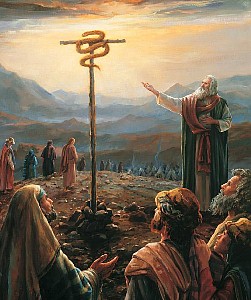
Numbers 21 tells us a story of the children of Israel being bitten by fiery serpents that caused the death of many. Moses is told to make a serpent out of brass and raise it up for the people to see. If the people looked to it, then they would be saved. If not, they would die. 
Seems pretty simple, right? If it is going to save you, then why not try it right?


In this story, the serpent of brass represents Christ. He was raised up on the cross, after suffering in Gethsemane, so that all might be saved. All it takes for us to receive that power, is to look to him. If we direct our lives towards him, living the way He did, acting the way He would have us act, then we can be saved. Whether or not we do it, He is still there. His atonement still happened and is available to us. Just as the brass serpent was raised and its saving power was there for the people to use.
What saved the people was looking to it. Some did and they were saved. Others didn't because they felt it was too simple, or they didn't believe it would work. 
So it is for us. Are we going to worship because we can't believe it would work? Because things stand in our way? Because the world tells us that it is out of date, and our beliefs are not in popular view? Are we going to let other imperfect people, who are in the middle of working out their own impurities stand in the way of cleaning up our own imperfections? Are we going to sacrifice our own spiritual lives for the sake of it being difficult?

God does not want us to worship him for his own self pleasure. That seems pretty selfish for someone who is willing to sacrifice his own Son for the sake of all mankind. It is purely for our benefit. We do not have to be perfect to worship Him. Worshipping Him is how we become perfect. He wants us to return to Him. He wants to help us. But He can't if we aren't willing and ready to receive it. 

I know that God lives. I know that everything He does is for the benefit of mankind, as well as for the benefit of each individual soul. He is aware of each and every one of us. His commandments are to help us and protect us from the painful consequences of sin. It is through following him that we can find joy and happiness in our lives. That doesn't mean we won't prevented from feeling heartache and pain. But He will help us through that, as well as to find joy in our journey. It is when our hearts are fully turned to him in worship that we receive those benefits. His benefit is the joy in having His children close to him and receiving all that He has in store for us. I have found this to be true for myself. It is my hope that you take these words, and do what you can to find out for yourself if it be true.


Sunday, June 14, 2015

"By Small and Simple Things..."

I recently moved to Boston. (Yay!) To start Occupational Therapy school. (Finally!) Which is why I have been radio silence for the past few weeks. This semester we only have a two classes. One of which is anatomy, including a cadaver lab. 

This anatomy class was not the only one I have taken in my life. I took many classes while working towards my associate's degree where I had to know the muscle attachments and their actions, alongside the traditional anatomy classes. At BYU, I took an functional musculoskeletal anatomy class where we had to know anatomy inside and out. I thought I had all of the spiritual insight about the human body I could possibly get. I mean, I went to BYU, I learned from LDS professors about how amazing the human body is. They understand it is an amazing gift from Heavenly Father, so what more could I possibly learn? Welp, that's what I get for thinking.

In class the other day, my teacher was discussing the brachial plexus. Which is a nerve complex that comes from the lower neck out to innervate the muscles in the shoulder, elbow, wrist and hands. My teacher was trying to explain to us how the nerves come from the spinal cord, and she goes off on a slight tangent. She said that the spinal cord is really small and boring when you look at it on a cadaver. It's just this white thing that isn't very big. Same with the brain. When the class started to comment on how that is weird, she commented that she was expecting large flashing neon lights to point out the spinal cord, and was disappointed that it what just this tiny little cord. The class laughed and we moved on. 

But then a scripture mastery verse came to mind. "By small and simple things are great things brought to pass... And the Lord God doth work by means to bring about his great and eternal purposes... and bringeth about the salvation of many souls" (Alma 37:6-7). 

Our body parts did not come with big, flashy, neon colors to say "Look at me! I'm a spinal cord!" or "Check out what I can do!" For one thing that would make anatomy class way too easy. Not to mention how uncomfortable would that be to have sticking out of our backs?

The jobs of the brain and spinal cord are incredible. They are what makes the whole rest of our body function properly. Our nerves are what makes our muscles move! But when you look at them inside the body, they are just these small, white pieces of tissue. They aren't that impressive to look at, but so incredible when we begin to understand all that they do.

This is just one example of small and simple things that Heavenly Father uses to accomplish his purposes. How many times do we pray for an answer or a testimony, demanding this big huge event to occur so that we can understand and believe? I mean it happened to Joseph Smith and other prophets. We've know that miracles happen. We hear those stories all the time in sacrament meeting, so isn't that supposed to happen when we ask for an answer? 

The prophet Elijah, a prophet who did a great number of things in his life, had this experience:
"And he said, Go forth, and stand upon the mount before the Lord. And, behold, the Lord passed by, and a great and strong wind rent the mountains, and brake in pieces the rocks before the Lord; but the  Lord was not in the windL and after the wind an earthquake; but the Lord was not in the earthquake: And after the earthquake a fire; but the Lord was not in the fire: and after the fire a still small voice. And it was so, when Elijah heard it, that he wrapped his face in his mantle, and went out" (1 Kings 19:11-13)

The end of this story is Elijah is told to call Elisha to be the next prophet. Not by an earth shattering voice was Elisha, another great prophet, called. Not an earth consuming fire. But by the still small voice.

Yes, there are times that the Lord uses big grand gestures. Those a big deal events for the world. Usually done to get the ignorant and prideful attention of the people who have blatantly turned away from him. But if you search the scriptures, it is not the big events that stick. Laman and Lemuel saw an angel. But they still feared Laban more than God. The Jews saw the miracle after miracle done by the Savior. Still the crucified Him. Huge events aren't what makes testimonies.

But what about Alma the Younger or Saul on the road to Damascus? Both made huge turn arounds after having an angel come to them and condemn their actions. This is what Alma said to his son how he gained a testimony:
"Do ye not suppose that I know of theses things myself? Behold, I testify unto you that I do know that these things whereof I have spoken are true. And how do ye suppose that I know of their surety? Behold, I say unto you they are made known unto me by the Holy Spirit of God. Behold, I have fasted and prayed many days that I might know these things of myself. And now I do know of myself that they are true; for the Lord God hath made them manifest unto me by his Holy Spirit; and this is the spirit of revelation which is in me" (Alma 5:45-46)

The angel didn't come to Alma, rack him with torment, and then when he finally turned to Christ, he suddenly have this huge testimony. Nope. He got it the same way that you and I receive our testimonies. By trying the word. Praying about principles. Fasting for answers. And acting on the knowledge that he received through the Holy Ghost. It is through doing the small things that we receive testimonies, make a huge difference in another person's life, and return back to live with the Father and Christ. As much as we want the big things to happen, how can they if we don't lay the foundation? How can we have a miraculous healing, if we first don't have the faith that it can happen? How can we run, if we don't first learn to sit up on our own?

Sure. It would be super cool if our spinal cords and brain were neon and stood out really well. It does some super cool things. But it is not necessary. What is necessary is to have a small control center so that we can do the big and little things while living comfortably. It is not necessary that God strikes every sinner down, or appear to every person wanting to know the truth. That does not build faith. Just as a neon spinal cord does not enhance our movements. It is when we are willing to take a step into the dark that we receive light. A small step may be what we need to start us down the path to eternal life.


Monday, May 4, 2015

BYU did NOT prepare me for my career

A week and a half ago, I graduated from BYU

I will be forever grateful for all that I have gained from receiving a BYU education. When people not of my faith would ask me why I chose BYU when I grew up in an area full of universities, I would give some explanation regarding cost and how BYU was cheaper in tuition and housing than just in state tuition and living at home. But that isn't the real reason why I chose there. When I set foot on campus as a freshman in high school, I immediately knew that this school was different and special. I felt drawn to it. Instead of my senses being bombarded by cigarette smoke and curse words, I felt peace and serenity. I didn't even have to sit in on a class to know that this school was the one for me. I knew I was going to have to work hard to get in and work hard while attending but I knew it was worth it. 

And it was. There were experiences and educational opportunities given to me at BYU that I would have no other place. With that being said, BYU did not prepare me for my future career. Some might be able to walk out of a university graduation and into their chosen field. That is not me. Occupational therapy asks for a graduate degree, and so that is what I am about to go earn. BYU doesn't have an Occupational Therapy program, and so my BYU educational experience did not prepare me to be an Occupational Therapist. But that is okay. I knew that was going to be the case. I didn't go to BYU to become an Occupational Therapist. I knew BYU could prepare me for so much more.

BYU prepared me for Occupational Therapy school
So I'm not ready to enter the work force as an occupational therapist. That's ok. I am prepared to enter occupational therapy school, in a program that is almost unmatched in its curriculum plan. Throughout my major, I studied the ethical dilemmas that face an occupational therapist. So when these problems arise in my clinicals, I will not only have the education to know how to handle it, I will have the decisions made beforehand as to how I would react. I have an understanding of the nerves work. Which is highly important because those are the exact skills I will be working with. My point is, as long as you do the research on majors, BYU's undergraduate education prepares students to go on professional schools, if they so choose.

I was spiritually prepared for sacred covenants
I basically walked out of the middle of my convocation and walked into the temple to receive my endowment. Ok there was stuff in between but that is pretty much what I felt like what happened. Throughout the session I never once felt out of place or that what was happening was weird. I felt completely like I came home and that I had been there before. Much of that can be attributed to the religious education that I was given at BYU. In my family history class, we spent the last two weeks talking about the history of the endowment, what goes on in the endowment and why we have it. In my Old Testament classes, we talked a lot about ancient temples and worship and how it relates to our times. My church history teacher taught us the history of the current endowment, how it came to be and how it has since been changed. I walked into the temple knowing what I was getting into (as much as I could). I wouldn't have had that ability if I had merely gone to institute and temple prep.

I learned how to put religion and secular education together
At BYU what I learned in my physics class was applied in my Old Testament class when we discussed the creation. My chemistry teacher flat out told us that his class was a religion class, not a science class (What he didn't include in that statement that we had to rely on our ability to pray to pass his tests, rather than our ability to learn.). Our discussion of trials in my Book of Mormon class had application in my basic athletic training class discussion on the principle of overload and adaptation. My Old Testament teacher was able to put a life metaphor to what I was learning in my ceramics class (that's a whole different blog post). Nearly every class, religion or not, started with a prayer. BYU didn't teach me I either had to have science or religion. BYU used science to prove religion, and religion to further scientific application. That is an education you would not be able to get anywhere else.

I was prepared to serve my fellow man
BYU's classic sign says "Enter to Learn, Go Forth to Serve." I will admit that I did not serve as much as BYU as I should have or could have. The only time I was involved with a service organization was for the blue foam slide, and it was so I could have unlimited runs after the crowd was gone. But I had many church leaders that taught me how to serve in the church. My teachers showed me what it was like to be understanding and accommodating to other's needs. I learned how I could serve in little ways, reaching out to the one with little recognition over the large recognition and not making much of a difference. My chosen field is a service field. I will be able to combine the education on service I had, inside and outside the classroom, at BYU with the OT education in graduate school to best serve my fellow man.

So BYU did not prepare me to sit for the licensing test to become an occupational therapist. No undergraduate degree would have. It requires a masters or better. BYU was not my chosen school because it would make me a better OT. That is a side benefit. I chose BYU because it would make me a better person and prepare me for my life. I feel like I can be of better service to my fellow man and to my Father in Heaven because of my BYU education. Is BYU perfect? Nope. But there isn't a university that is, except the temple. But I am forever a better person because of my BYU educational experience.

Sunday, March 22, 2015

Miracles Take Time...and Work

I have been thinking a lot about miracles today and I had a thought that I hadn't had before.

This week I found out that I was accepted into occupational therapy school. As you can imagine, I am incredibly excited to start this new adventure. Throughout the application process, the observation hours, the interviews and now the preparations to go I have been thinking a lot about what it will be like to actually be an occupational therapist. In a previous post, I talked about how I realized that it is my mission from the Lord. And this week I have come one step closer to being able to "enter the mission field" so to speak. 

So what does OT have to do with my new perspective on miracles?

Today in Sunday school we were talking about burdens and how the Savior can make them light. The context that we were discussing these burdens had to do with following all of the rules that the Pharisees had put on the people in order to keep the Law of Moses. We then read examples of the Savior healing on the Sabbath day and the Pharisees were trying to point out that he was doing wrong. In their eyes no work was to be done on the Sabbath, no matter the intentions and good that it could accomplish. 

While this discussion was going on, my mind went off into another direction. 

I thought of all of the "famous" miracles. You know, the ones that we always talk about because they are so cool. The woman with the issue of blood being healed by touching the Savior's cloak. The parting of the Red Sea. Alma the Younger and the sons of Mosiah seeing an angel and having a miraculous change of heart. The raising of the dead. The Day of Miracles in Nauvoo when all of the saints were sick with malaria. 
This one is my personal favorite to read about:

Why are they so cool?
The instantaneous change that was experienced. Faith was tested. Results happened instantly. Results that could not be replicated by anyone else without proper priesthood authority and authorization.

Then I thought of a discussion I had had with one of my friends who just got off of a mission. I was telling her about how I had felt that occupational therapy was my mission. She told me about in a class she was auditing on health professions, an occupational therapist had come in a talked about the profession. She told me that the therapist loved her job because she got to be the hands to the Savior daily. She gets to spread his healing to her patients.
When I recalled this, I thought "But therapy takes time to see results. The Savior's miracles happened right away. How is it that I will get to be the Savior's healing hands when I won't be able to get instant results?"

Then I remembered other, less famous, miracles. Naaman, an Assyrian, was healed of leprosy only after he washed in the river Jordan seven times (2 Kings 5). It took Nephi and his brothers three tries to get the brass plates from the wicked Laban (1 Nephi 3-4). The Apostle Peter went from weak faith to leader of the church. Not in one day, week or month. But it took learning at the Savior's feet for 3 years and then months after the Savior was resurrected. The Book of Mormon and Bible were not translated in a couple of days. Even some of the Savior's miracles took actions and stages: 

(The miracle is over at 3:40)

Was faith tested in these miracles? Definitely. But they also took time and work for the miracles to be fully complete. 

We live in a time when everything happens instantly. It takes me longer to tie my shoes that it does to look up the weather forecast in Tahiti. We are so easily caught up in the moment. You know how the cheer goes." What do we want?" (Insert want here)" When do we want it?" "Now!"
 That is how society lives their lives. 

Yes, instantaneous miracles do occur. The miracles recorded in the scriptures teach us that. I have had  priesthood blessings of healing that the healing took place as soon the hands were placed on my head. It can happen that way if the Lord wills it.
On the other hand, I have had other blessings of healing (for a similar issue and other problems), that took hours, days or years to come true. I had to place my trust in my Father in Heaven, and completely turn my will over to him in order for that answer to come. 

Repentance doesn't happen in one day. Conversion does not come with a single spiritual experience. Healing (physically, spiritually or emotionally) does not come with a single treatment. 

It takes the effort of restoring all that was done wrong and never returning to that sin to be forgiven. It takes daily spiritual experiences to make the conversion stick. It takes continuous prayer, rehabilitative work and fighting the urge to give up that healing is brought about. 

It is my testimony that prayers are heard and answered. All of God's promises come true. I know that He has a plan for each of us. Sometimes the instant reward is what we need. But more often than not, it is the learning how to work towards our goal of receiving the desired blessings is what we need. It is through our work, patience and diligence that molds us into the people that are worthy of those blessings. They may not come today, next month, in five years, or even in this life. But I promise, they do come.


For further study:
Miracles- Then and Now by Thomas S. Monson November 1992
The Miracle I Needed- New Era February 2010